
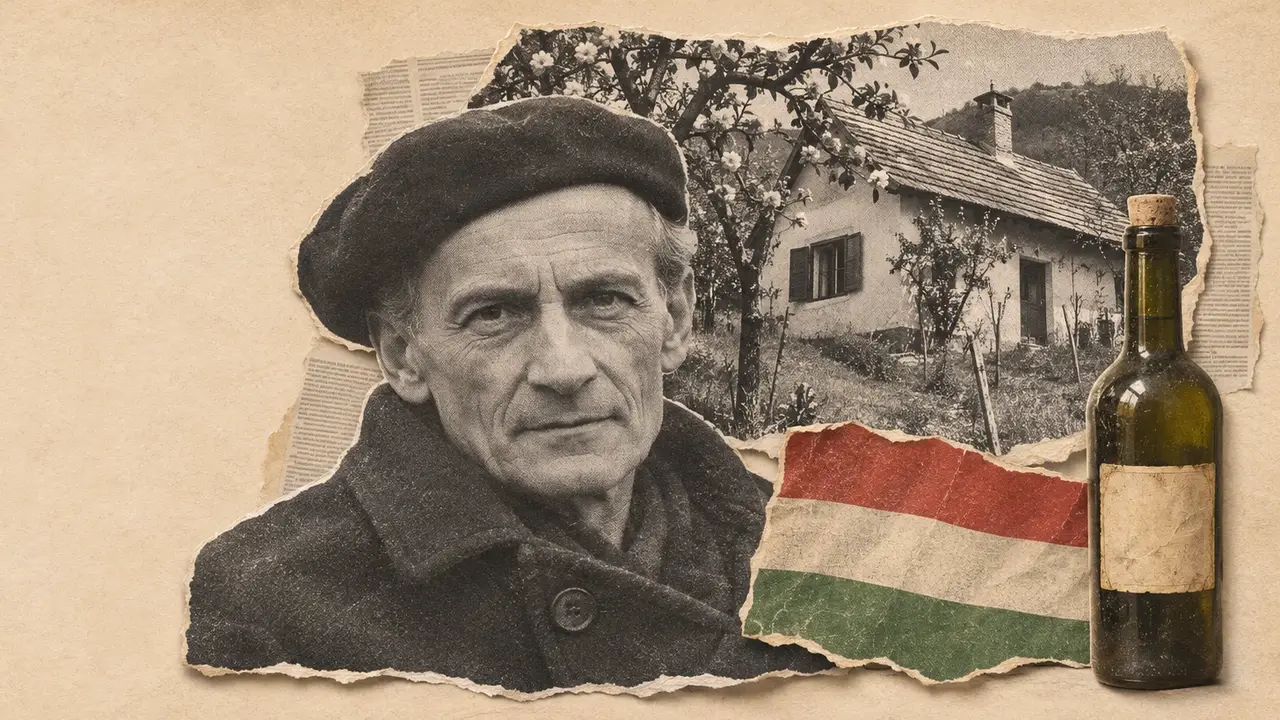
Walk into the restroom at Vinopest and you might hear someone making the case that a tavern matters more than Parliament. That’s a reading from The Philosophy of Wine, an essay by the Hungarian writer Béla Hamvas. We play it in Hungarian. At the bar, we pour the wine that bears his name, a creamy Chardonnay from Kőhegybor, a winery in nearby Szentendre.
Who was Béla Hamvas?
In Hungary, you’ll see his name written Hamvas Béla, with the family name first. He was born in 1897 in Eperjes, then part of the Kingdom of Hungary and now Prešov, Slovakia. He spent much of his working life in Budapest, where he was a librarian and wrote essays on subjects as varied as religion and modern art.
Hamvas wrote The Philosophy of Wine in the years immediately after World War II. The war had left Budapest badly damaged, and Hungary was soon pulled into the Soviet bloc. In 1948, as the Soviet-backed Communist Party tightened its grip on the country, Hamvas lost his library job and was pushed out of publishing. He spent the next few years growing fruit in a garden in Szentendre and writing Carnival (Karnevál), a novel that only appeared in print in 1985, seventeen years after his death. From 1951 he worked at power plant construction sites, including as a warehouse clerk. He kept writing and translating.
What does wine have to do with philosophy?
“I decided to write a prayer book for the atheists.” That’s how Hamvas opens the essay. A few pages into his catalogue of Hungarian wines, a discussion of wines grown on sandy soils leads him to rank the tavern above Parliament. (The Philosophy of Wine, translated by Gábor Csepregi, pp. 5, 50–51.)
If you came to Hungary knowing Tokaji Aszú, the sweet wine from Tokaj, Hamvas offers a few other places to look. He writes about Somló, a small volcanic wine district in western Hungary known for whites such as Juhfark. He also makes room for the everyday wines people actually drink in taverns. You get a sense of how much Hungarian wine culture happens over an ordinary glass, at an ordinary table.
Elsewhere, in an essay called A zarándok búcsúja (literally, “The Pilgrim’s Farewell”), Hamvas asks readers to share what they’ve gained, learned, and lived through. That’s the part we think about when someone orders a bottle and starts asking for extra glasses.
From a garden in Szentendre to a glass in Budapest
Szentendre is a small town on the Danube north of Budapest. Many visitors go for the narrow streets and churches, traces of the Serbian and other settlers who shaped the old town. It also had a thriving wine trade. In the late nineteenth century, phylloxera, a tiny insect that feeds on grapevine roots, devastated its vineyards.
Kőhegybor is part of the effort to bring winemaking back to Szentendre. The winery takes its name from Kőhegy, the volcanic hill above town where Hamvas tended his brother-in-law’s garden. Its Hamvas Chardonnay gives us a way to tell that story over a glass, beginning with a grape most American wine drinkers already know.
You’ll find Vinopest Wine Bar and Wine Shop at József körút 34, near Rákóczi Square and its market hall in Budapest’s Eighth District, on the Pest side of the Danube. Ask us for a glass of Kőhegybor’s Hamvas Chardonnay. If the reading leaves you curious, look for The Philosophy of Wine in Gábor Csepregi’s English translation.
Sources
- MEDIO Kiadó – The Philosophy of Wine
- Múzeum Antikvárium – Gábor Csepregi’s English translation
- Nemzeti Örökség Intézete – Béla Hamvas
- Szentendre – Hamvas’s years in Szentendre
- Magyar Bor – Kőhegybor
- Magyar Bor – Juhfark
- Szentendre tourism – A short history of Szentendre
- U.S. Department of State – Hungary, historical background